
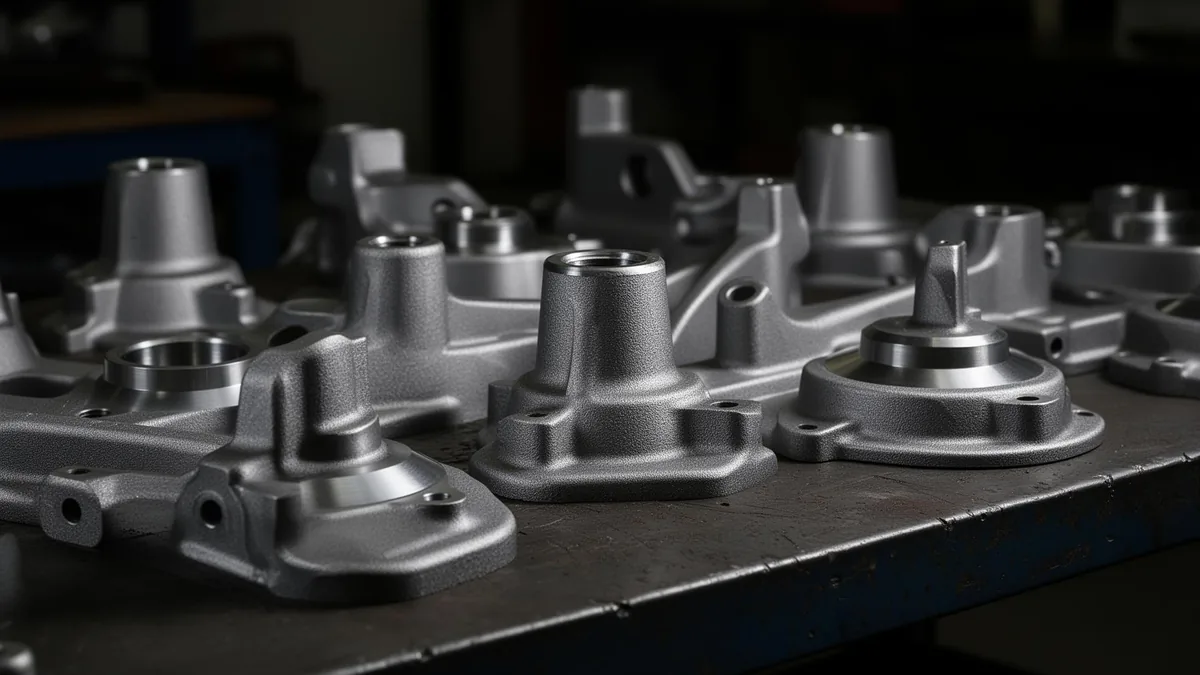
Casting Range
Precision Across the Spectrum — From 0.5 kg to 650 kg
Intricate Precision Castings
We specialize in manufacturing small, intricate ferrous castings, weighing from as little as 0.5 kilograms. These lightweight components are engineered for applications demanding exceptional precision and fine detail, critical for high-performance systems.
Applications: Specialized automotive components, precision parts for motor components, pump components, and general engineering.
Robust & Heavy-Duty Solutions
Our capabilities extend to producing robust and heavy-duty castings, with individual pieces weighing up to 650 KGs. These larger components are designed for strength, durability, and reliable performance in demanding industrial environments.
Applications: Large automobile casings, textile power loom frames, construction machinery, agricultural equipment, and renewable energy components.
Where Our Castings Work
Automotive
Flywheel pulleys, casings, and specialized components
Pumps
Impellers, housings, and precision pump components
Textile Machinery
Power loom frame castings and machine components
Agriculture
Tractor parts and durable agri equipment castings
Construction
Heavy-duty components for construction machinery
General Engineering
Custom castings for diverse engineering applications
Grades We Cast
We produce the full range of grey iron and SG (ductile) iron grades. Equivalents below are nearest-match across standards; the grade is always confirmed against your drawing before production.
Grey Iron — IS 210
| IS Grade | EN Equivalent | ASTM | DIN | Min. Tensile (MPa) | Typical Use |
|---|---|---|---|---|---|
| FG 150 | EN-GJL-150 | Class 20 | GG 15 | 150 | Light-duty covers, casings and non-stressed housings |
| FG 200 | EN-GJL-200 | Class 30 | GG 20 | 200 | General engineering castings, pump bodies, brackets |
| FG 220 | EN-GJL-200/250 | Class 30/35 | GG 20/25 | 220 | Intermediate grade for general machine parts |
| FG 260 | EN-GJL-250 | Class 35/40 | GG 25 | 260 | The most widely specified grade: machine beds, frames, housings |
| FG 300 | EN-GJL-300 | Class 45 | GG 30 | 300 | Higher-strength machine tool and hydraulic components |
| FG 350 | EN-GJL-350 | Class 50 | GG 35 | 350 | Heavy-duty applications needing maximum grey iron strength |
| FG 400 | — | Class 60 | — | 400 | Highest grey iron grade, specified for demanding duty |
SG / Ductile Iron — IS 1865
| IS Grade | EN Equivalent | ASTM | DIN | Min. Tensile (MPa) | Typical Use |
|---|---|---|---|---|---|
| SG 350/22 | EN-GJS-350-22 | — | — | 350 | Ferritic, maximum ductility and low-temperature impact resistance |
| SG 400/15 | EN-GJS-400-15 | 60-40-18 | GGG 40 | 400 | Ferritic, good elongation and machinability; general engineering |
| SG 450/10 | EN-GJS-450-10 | 65-45-12 | — | 450 | Balanced strength and ductility for automotive and agricultural parts |
| SG 500/7 | EN-GJS-500-7 | — | GGG 50 | 500 | Ferritic-pearlitic; pump and valve bodies, gearbox housings |
| SG 600/3 | EN-GJS-600-3 | 80-55-06 | GGG 60 | 600 | Pearlitic; higher strength for loaded machinery components |
| SG 700/2 | EN-GJS-700-2 | 100-70-03 | GGG 70 | 700 | Pearlitic; wear resistance and high strength |
| SG 800/2 | EN-GJS-800-2 | 120-90-02 | GGG 80 | 800 | High-strength applications replacing cast or fabricated steel |
Chemistry is checked by spectrometer at the melting stage and mechanical properties are verified on a universal testing machine, so the delivered grade is confirmed by test rather than assumed. Working to a standard we have not listed? Send the specification and we will confirm whether we can meet it — get in touch.
How the Range Is Produced
Two moulding lines cover the full weight range, with pattern making and machining handled through established partners.
Moulding
Two ARPA jolt-squeeze lines run in parallel. The ARPA 300 handles the smaller, more intricate end of the range where detail and repeatability matter most; the larger ARPA 1300 takes the heavy sections through to our 650 kg maximum. Both green sand and CO2 moulding are available.
Pattern Making
Patterns are made through established pattern shop partners in Coimbatore, so tooling is developed locally and can be corrected quickly during sampling rather than waiting on a distant supplier. Send a drawing or 3D model and we will advise on pattern construction and likely tooling cost.
Machining
Machining is carried out through partner machine shops, which means castings can be supplied either as cast or fully machined and ready to fit. Coimbatore's engineering base makes that capacity readily available close to the foundry.
Frequently Asked Questions
Which grades of grey iron do you cast?
We produce the full range of grey iron grades to IS 210, from FG 150 through FG 200, FG 220, FG 260, FG 300 and FG 350 up to FG 400. These correspond broadly to EN-GJL-150 to EN-GJL-350 under EN 1561, ASTM A48 Class 20 to Class 60, and GG 15 to GG 35 under DIN.
Which grades of SG or ductile iron do you cast?
We produce the full range of SG iron grades to IS 1865, including SG 350/22, SG 400/15, SG 450/10, SG 500/7, SG 600/3, SG 700/2 and SG 800/2. These correspond to EN-GJS-350-22 through EN-GJS-800-2 under EN 1563, ASTM A536 grades 60-40-18 to 120-90-02, and GGG 40 to GGG 80 under DIN.
Can you cast to EN, ASTM or DIN specifications rather than Indian standards?
Yes. Grades are commonly specified to EN 1561 and EN 1563, ASTM A48 and A536, or DIN, and we work to whichever standard your drawing calls for. Because standards differ in test bar size and in which properties are guaranteed, the exact grade is confirmed against your drawing before production rather than assumed from a conversion table.
How is the grade verified before dispatch?
Chemical composition is checked by spectrometer at the melting stage and mechanical properties are verified on a universal testing machine, supported by hardness testing and microstructure examination on an optical microscope with image analyser. The delivered grade is confirmed by test rather than assumed.
Do you make the patterns, or do I need to supply them?
Patterns are made through established pattern shop partners in Coimbatore, so tooling can be developed locally and corrected quickly during sampling. You are also welcome to supply your own patterns. Send a drawing or 3D model and we will advise on pattern construction and likely tooling cost.
Can castings be supplied machined?
Yes. Machining is carried out through partner machine shops close to the foundry, so castings can be supplied either as cast or fully machined and ready to fit, depending on what you need.
What is the largest casting you can produce?
Individual castings up to 650 kg. The heavier end of the range is moulded on our ARPA 1300 line, while smaller and more intricate work runs on the ARPA 300.